Abstract
Since the effects of various irreversible losses and cycle conditions on the internal combustion engine performance are significant, it is important to compare the effects of the parameters on the performance in a cycle study. Thermodynamic cycle studies should take into account the irreversible losses such as internal irreversibility, friction losses, heat transfer losses, and the variation of the specific heat of the working fluid. This study aims at deriving the analytic equation with respect to ecological function of the irreversible Dual-Miller cycle (DMC) by using the specific heat model of polynomial, and comparing results of performance calculation of different friction losses, and analyzing the effect of the cycle parameters for optimum performance. The calculation results show that the friction loss has a considerable influence on the engine performance, but there is no significant difference in the choice of the cycle parameters for optimum performance. It is also found that optimizing the ecological function is an effective way to simultaneously increase the power and efficiency, and the friction loss is not affected. The cut-off ratio, which gives the ecological function maximum, is between the cut-off ratio, which gives the power and efficiency maximum, and the Miller cycle ratio, respectively, which is closer to the efficiency maximum. The Miller cycle ratio that maximizes performance is slightly larger than the cut-off ratio. The presented models and results are expected to provide guidelines for the design and optimization of DMC engines, and for the performance improvement and to perform the cycle modeling close to the cycle of the actual engine.
Keywords
Dual-Miller Cycle, Friction Loss, Ecological Function, Irreversible Loss, Cycle Parameter
1. Introduction
Thermodynamic analysis of cycles is performed in order to evaluate theoretical boundaries of the performance and find out the ways of improving performance and compare the performance characteristics of different cycles. The studies on internal combustion engine (ICE) cycles can be divided into the following four aspects: the optimum performances of air standard ICE cycles, the optimum piston motion path of ICE cycles, the performance limits of ICE cycles with non-uniform working fluid (WF), and performance simulation of ICE cycles
| [1] | Y. L. Ge, L. G. Chen, F. R. Sun, Progress in finite time thermodynamic studies for internal combustion engine cycles, Entropy 18(4) (2016) 139. https://doi.org/10.3390/e18040139 |
[1]
. Thermodynamic analysis of ICE cycles, models describing basic characteristics in the real process of engine can be established by using the FTT (Finite-time thermodynamics, FTT)
| [1] | Y. L. Ge, L. G. Chen, F. R. Sun, Progress in finite time thermodynamic studies for internal combustion engine cycles, Entropy 18(4) (2016) 139. https://doi.org/10.3390/e18040139 |
| [2] | Ge Y, Wu H, Chen L, et al. Finite time and finite speed thermodynamic optimization for an irreversible Atkinson cycle. Energy, 2023, 270: 126856. |
| [3] | Andresen, B.; Salamon, P. Future perspectives of finite-time thermodynamics. Entropy 2022, 24, 690. |
[1-3]
.
In the recent years, numerous research works on the performances of air standard ICE cycles are focused on the reduction of exhaust emission and improvement of the engine performance
| [1] | Y. L. Ge, L. G. Chen, F. R. Sun, Progress in finite time thermodynamic studies for internal combustion engine cycles, Entropy 18(4) (2016) 139. https://doi.org/10.3390/e18040139 |
| [4] | C. Q. Li, Y. D. Wang, B. Jia, A. P. Roskilly, Application of Miller cycle with turbocharger and ethanol to reduce NOx and particulates emissions from diesel engine - A numerical approach with model validations, Appl. Therm. Eng. 150(2019) 904-911. https://doi.org/10.1016/j.applthermaleng.2019.01.056 |
| [5] | Gonca. G, Thermodynamic analysis and performance maps for the irreversible Dual-Atkinson cycle engine (DACE) with considerations of temperature-dependent specific heats, heat transfer and friction losses, Energy Convers. Manage. 111(2016) 205-216. https://doi.org/10.1016/j.enconman.2015.12.059 |
| [6] | Wang P, Tang X, Shi L, Ni X, Hu Z, Deng K (2021) Experimental investigation of the influences of Miller cycle combined with EGR on performance, energy and exergy characteristics of a four-stroke marine regulated two-stage turbocharged diesel engine. Fuel 300, 120940. https://doi.org/10.1016/j.fuel.2021.120940 |
| [7] | Chen, L., Zhu, F., Shi, S. et al. Power and efficiency optimizations of Maisotsenko-Atkinson, Dual and Miller cycles and performance comparisons with corresponding traditional cycles. Sci. China Technol. Sci. 66, 3393-3411 (2023). https://doi.org/10.1007/s11431-023-2444-1 |
| [8] | Zang, P. C.; Chen, L. G.; Ge, Y. L.; Shi, S. S. Four-objective optimization for an irreversible porous medium cycle with linear variation in working fluid’s specific heat. Entropy 2022, 24, 1074. |
| [9] | Ahmadi, M. H.; Pourkiaei, S. M.; Ghazvini, M.; Pourfayaz, F. Thermodynamic assessment and optimization of performance of irreversible Atkinson cycle. Iran. J. Chem. Chem. Eng. 2020, 39, 267-280. |
[1, 4-9]
. Numerous investigations have been conducted to improve engine performance and reduce NOx emissions using the Miller cycle. Moreover, the ICE design through the Miller cycle has been optimized to reduce NOx emissions and improve fuel economy
| [10] | Georgiou C, Azimov U (2020) Analysis and multi-parametric optimisation of the performance and exhaust gas emissions of a heavy-duty diesel engine operating on miller cycle. Energies 13(14): 3724. https://doi.org/10.3390/en13143724 |
| [11] | Zerom M, Gonca. G (2020) Multi-criteria performance analysis of dual miller cycle-Organic rankine cycle combined power plant. Energy Conversion Management 221, 113121. https://doi.org/10.1016/j.enconman.2020.113121 |
| [12] | Shengli Wei, Chengcheng Wu, Shuzhe Yan, Tongyuan Ding, Jie Chen (2022). Miller Cycle with Early Intake Valve Closing in Marine Medium-Speed Diesel Engines. Journal of Marine Science and Application, 21(1): 151-160. https://doi.org/10.1007/s11804-022-00250-5 |
[10-12]
. Many researches show that Dual-Diesel cycle (DDC) has an advantage of high power and Otto-Miller cycle (OMC) has an advantage of low NOx emissions. DMC has the advantages of high power and low NOx emissions simultaneously, it is because the heat addition processes of DMC are similar to those of DDC, and the heat rejection processes of DMC are similar to those of OMC. However, in order to apply DMC for ICE design, there should be more complete theory and more mature technology.
So far, some progress has been made in the theoretical analysis and application of overexpansion cycles, including the Miller cycle, some of which have already been commercialized.
A review of the cycle studies of overexpansion ICE is presented, which optimizes the design and operating parameters with one or more performance parameters prioritized among performance parameters such as power, thermal efficiency, power density, exergy, and ecological functions as objective functions.
In our previous work, we have carried out a theoretical study of the cycle, such as the Atkinson cycle and the Miller cycle engine, based on finite-time thermodynamic theory. Here, the working fluid specific heat model can be broadly classified into constant specific heat model, variable specific heat model, and variable specific heat ratio model, using friction loss model with respect to piston mean velocity. Ge, Y
considered the power and compression ratio relationship of Atkinson cycle in the presence of heat transfer loss and friction loss, and found that heat transfer and friction loss have a serious effect on performance. Zhao et al.
optimized power output and efficiency of the irreversible OMC with heat transfer loss. They optimized power output and efficiency of the cycle with respect to the pressure ratio (maximum/minimum) of the working substance and analyzed optimum criteria of some important parameters such as the power output, efficiency. Mousapour et al.
| [15] | A. Mousapour and M. M. Rashidi, Performance Evaluation of an Air-Standard Miller Cycle with Consideration of Heat Losses, International Journal of Mechatronics, Electrical and Computer Technology, Vol. 4(12) (2014) 1175-1191. |
[15]
analyzed the power and efficiency of the irreversible OMC and investigated the influences of the Miller cycle ratio and initial temperature, heat transfer on compression ratio. Gonca et al.
| [16] | Gonca. G, Sahin. B, Ust. Y, Performance maps for an air-standard irreversible Dual-Miller cycle (DMC) with late inlet valve closing (LIVC) version, Energy 54(2013) 285-290. https://doi.org/10.1016/j.energy.2013.02.004 |
[16]
made a performance analysis based on the power output, thermal efficiency, maximum power output and maximum thermal efficiency criteria for an air standard irreversible DMC with late inlet valve closing (LIVC) version which covers internal irreversibility owing to the irreversible-adiabatic processes. They studied the influences of cycle temperature ratio and cycle pressure ratio of the DMC on the optimum performances as well. Ust et al.
| [17] | Y. Ust, F. Arslan, I. Ozsari, M. Cakir, Thermodynamic performance analysis and optimization of DMC (Dual Miller Cycle) cogeneration system by considering exergetic performance coefficient and total exergy output criteria, Energy 90(2015) 552-559. https://doi.org/10.1016/j.energy.2015.07.081 |
[17]
optimized total exergy output and exergetic performance coefficient for an irreversible DMC. Their results show that thermal efficiency will get low when optimizing power, and on the contrary, power will turn low when optimizing η. Gonca et al.
| [18] | Gonca. G, Sahin. B, Ust. Y, Parlak. A, Comprehensive performance analyses and optimization of the irreversible thermodynamic cycle engines (TCE) under maximum power (MP) and maximum power density (MPD) conditions. Appl. Therm. Eng. 85(2015) 9-20. https://doi.org/10.1016/j.applthermaleng.2015.02.041 |
[18]
investigated the comprehensive performance analyses and comparisons for irreversible thermodynamic cycle engines based on the power output, power density, thermal efficiency, maximum dimensionless power output (MP), maximum dimensionless power density (MPD) and maximum thermal efficiency (MEF) criteria. Gonca et al.
| [19] | Gonca. G, Sahin. B, Ust. Y, Investigation of Heat Transfer Influences on Performance of Air-Standard Irreversible Dual-Miller Cycle. Journal of Thermophysics and Heat Transfer 29(2015) 678-693. https://doi.org/10.2514/1.T4512 |
[19]
investigated the performance of the irreversible Dual-Miller cycle with LIVC, taking into consideration the influences of heat transfer loss and internal irreversibility. Mehmet CAKIR
analyzed the performance of an irreversible OMC in consideration of heat transfer effects and internal irreversibility. In the analyses, the influences of the Miller cycle ratio, combustion, and heat loss constants, and inlet temperature have been investigated. Gonca et al.
carried out an ecological performance analyses and optimization of irreversible gas cycle engines such as Atkinson cycle, Otto cycle, Diesel cycle, Miller cycle, DDC, DMC engines based on the ecological coefficient of performance criterion which covers internal irreversibility, heat leak and finite-rate of heat transfer. Gonca et al.
| [22] | Gonca. G, Comparative performance analyses of irreversible OMCE (Otto Miller cycle engine)-DiMCE (Diesel miller cycle engine)-DMCE (Dual Miller cycle engine), Energy 109(2016) 152-159. https://doi.org/10.1016/j.energy.2016.04.049 |
[22]
carried out the comparative performance analyses of the irreversible OMC engine, Diesel Miller cycle engine and DMC engine based on the maximum dimensionless power output, maximum dimensionless power density. Ebrahimi
showed that the work output the DMC has linear relationship with the intake temperature, friction coefficient, working fluid, chemical energy release by combustion and heat-transfer coefficient. Wu et al.
| [24] | Z. X. Wu, L. G. Chen, H. J. Feng, Thermodynamic Optimization for an Endoreversible Dual-Miller Cycle (DMC) with Finite Speed of Piston, Entropy 20(2018) 165. https://doi.org/10.3390/e20030165 |
[24]
investigated power output, thermal efficiency and ecological function characteristics of an endo-reversible DMC with finite speed of the piston. Ust et al.
| [25] | Y. UST, I. OZSARI, F. ARSLAN, A. SAFA, A THEORETICAL PERFORMANCE INVESTIGATION OF IRREVERSIBLE INTERNAL COMBUSTION ENGINE NAMED AS DUAL-MILLER CYCLE Sigma J Eng & Nat Sci 38(1) (2020) 459-473. |
[25]
carried out comparative performance analysis and optimization based on the non-dimensional power output and thermal efficiency criteria for an irreversible DMC. The effects of the design parameters such as cycle compression ratio, cut-off ratio and Miller cycle ratio were investigated. You et al.
| [26] | J. You, L. G. Chen, Z. X. Wu, F. R. Sun, Thermodynamic performance of DualMiller cycle (DMC) with polytropic processes based on power output, thermal efficiency and ecological function, Sci. China: Tech. Sci. 61(3) (2018) 453-463. |
[26]
described the model of the DMC with two polytropic processes and heat transfer loss and analyzed influences of compression ratio, cut-off ratio, polytropic exponent on the performance. Shahriyar et al.
| [27] | S. Abedinnezhad, M. H. Ahmadi, S. M. Pourkiaei, F. Pourfayaz, A. Mosavi, M. Feidt, S. Shamshirband, Thermodynamic Assessment and Multi-Objective Optimization of Performance of Irreversible Dual-Miller Cycle, Energies 12(4000) (2019) 1-25. |
[27]
investigated the performance and the effect of critical parameters on the performance of the DMC with two polytropic processes. Multi-objective optimization was performed to obtain the best point of performance of the DMC. Researches mentioned above investigated an air standard Miller cycle with a constant specific heat.
In addition, studies of an air standard Miller cycle have been performed on the performance analysis and optimization of the cycle with the variable specific heat of WF. Al-Sarkhi et al.
investigated the influences of the linearly variable specific heat characteristic on the OMC. Al-Sarkhi et al.
analyzed the performance of a Miller engine under different specific heat models (i.e., constant, linear, and fourth order polynomial). Their results show that an accurate model such as fourth order polynomial is essential for accurate prediction of cycle performance. Lin and Hou
| [30] | J. C. Lin, S. S. Hou, Performance analysis of an air-standard Miller cycle with considerations of heat loss as a percentage of fuel's energy, friction and variable specific heats of working fluid, Int. J. Therm. Sci. 47(2) (2008) 182-191. |
[30]
investigated the effects of heat loss characterized by a percentage of fuel's energy, friction and variable specific heats of working fluid on the performance of an air-standard Miller cycle. Xing
| [31] | X. M. YE, Effect of variable heat capacities on performance of an irreversible Miller heat engine, Energy. 6(3) (2012) 280-284. |
[31]
analyzed the performance of the irreversible OMC with heat leak losses, the irreversibility, the specific heat of working fluid linearly varying with its temperature. Ebrahimi et al.
| [32] | R. Ebrahimi, M. Hoseinpour, Performance Analysis of Irreversible Miller Cycle Under Variable Compression Ratio, JOURNAL OF THERMOPHYSICS AND HEAT TRANSFER 27(3) (2013)542-548. |
[32]
investigated the performance of the irreversible Miller cycle with the nonlinear specific heats of a working fluid, the frictional loss related to the mean velocity of the piston, and heat transfer loss through the cylinder wall. Lin et al.
investigated the performance of an irreversible air standard Miller cycle in a four-stroke free-piston engine with the variable specific heats, the heat transfer loss as a percentage of fuel's energy and the friction loss. Dobrucali
| [34] | E. Dobrucali, The effects of the engine design and running parameters on the performance of a Otto-Miller Cycle engine, Energy 103(2016) 119-126. |
[34]
carried out the performance analysis for an irreversible OMC has been presented by taking into consideration heat transfer effects, frictions, variable specific heats. The results demonstrate that the engine design and running parameters have considerable effects on the cycle thermodynamic performance. Gonca
| [35] | G. Gonca, AN OPTIMIZATION STUDY ON AN ECO-FRIENDLY ENGINE CYCLE NAMED AS DUAL-MILLER CYCLE (DMC) FOR MARINE VEHICLES, POLISH MARITIME RESEARCH 24(2017) 86-98. |
[35]
carried out the performance investigation of the power, power density, effective efficiency of a DMC engine with nonlinear specific heats. In this study, influences of the engine design and operating parameters on the performance characteristics and energy losses of a diesel engine have been investigated. G. Gonca and B. Sahin
numerically and empirically investigated the influences of the combination of the steam injection method, Miller cycle and turbo charging methods on the performance of a direct injection diesel engine. This report also showed a comprehensive comparison of the results of experiments. Ge et al.
investigated the ecological function performances of an irreversible Otto cycle considering internal irreversibility loss, friction loss and heat transfer loss, nonlinear specific heats. Their results show that optimization of the exergy-based ecological function not only represents a compromise between the power output and the rate of entropy generation but also represents a compromise between the power output and the thermal efficiency, the specific heat models have no qualitative effect and only have quantitative effect on the performance characteristics of ecological function versus power output and ecological function versus efficiency. Ebrahimi
| [38] | R. Ebrahimi, Thermodynamic modeling of performance of a Miller cycle with engine speed and variable specific heat ratio of working fluid, Comput. Math. Appl. 62(5) (2011) 2169-2176. |
[38]
analyzed the effect of the variable specific heats and engine speed on the power output and the efficiency of cycle. In order to make thermodynamic and economic performances of the heat engine cycle reach ideal values simultaneously, Angulo-Brown firstly proposed the ecological function, Yan
| [39] | Z. J. Yan, Comment on ‘‘ecological optimization criterion for finite-time heat engines”, J. Appl. Phys. 73(7) (1993) 3583. |
[39]
later revised as
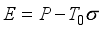
. Gonca et al.
| [40] | Gonca. G, Thermo-ecological analysis of irreversible Dual-Miller cycle (DMC) engine based on the ecological coefficient of performance (ECOP) criterion, Iran. J. Sci. Technol. Trans. Mech. Eng. 41(4) (2017) 269-280. |
[40]
optimized the ecological function of irreversible Miller cycle with heat transfer loss. Wu et al.
| [41] | Z. X. Wu, L. G. Chen, Y. L. Ge, F. R. Sun, Thermodynamic optimization for an air-standard irreversible Dual-Miller cycle with linearly variable specific heat ratio of working fluid, Int. J. Heat Mass Transf 124(2018) 46-57. https://doi.org/10.1016/j.ijheatmasstransfer.2018.03.049 |
[41]
investigated an air-standard irreversible DMC with linearly variable SHR, and with heat transfer loss, friction loss and other internal irreversible losses. Their results indicated that the maximum power output, maximum efficiency and maximum ecological function of the DMC are superior to those of OC, DDC and OMC, and optimizing ecological function is the best compromise between optimizing power output and optimizing efficiency. Wu et al.
| [42] | Z. X. Wu, L. G. Chen, Y. L. Ge, F. R. Sun, Power, efficiency, ecological function and ecological coefficient of performance of an irreversible Dual-Miller cycle (DMC) with nonlinear variable specific heat ratio of working fluid, Eur. Phys. J. Plus 132(5) (2017) 203. |
[42]
optimized the ecological function of irreversible Miller cycle with internal irreversibility loss, friction loss and heat transfer loss, nonlinear specific heat ratio. Chen et al.
| [43] | L. G. Chen, Y. L. Ge, C. Liu, H. J. Feng, G. L. Lorenzini, Performance of Universal Reciprocating Heat-Engine Cycle with Variable Specific Heats Ratio of Working Fluid, Entropy 22(397) (2020) 1-13. https://doi.org/10.3390/e22040397 |
[43]
founded and analyzed an air standard universal reciprocating heat-engine cycle with heat transfer loss, friction loss and internal irreversibility loss. They analyzed performance characteristics of various special cycles (including Miller, Dual, Atkinson, Brayton, Diesel and Otto cycles) when the SHR of WF is constant and variable (including the SHR varied with linear function and nonlinear function of WF temperature). Gonca et al.
carried out the comprehensive performance examination of an engine running on Diesel-Miller cycle in terms of effective power, density of the effective power, and effective thermal efficiency using a novel thermodynamic simulation model. Their results show that variable specific heat values with respect to temperature variation for working fluid are used to get realistic results of engine performance.
Previous thermodynamic cycle studies based on finite-time thermodynamics have mostly dealt with heat transfer loss and friction loss in relatively simple terms. The heat transfer loss through the cylinder wall was assumed to be proportional to the average temperature difference between the working fluid and the cylinder wall. The heat transfer coefficient was considered constant, which did not change with the change of engine design parameters and cycle conditions. Also, the friction power loss term is considered only as viscous friction, which is related to the average piston speed, and the influence of important engine parameters such as cylinder pressure, stroke, etc. is not considered. In a real ICE, the heat transfer coefficient changes in response to changes in the charge pressure, temperature, average piston speed, etc. Moreover, in actual ICE, the frictional loss power is not only related to viscous friction associated with the average piston velocity, but also to the boundary friction affected by the maximum cylinder pressure. The influence of design and operating parameters on the heat transfer coefficient and boundary friction should be considered when establishing an FTT model of cycles. The results of the performance comparison analysis of several thermodynamic cycles in
| [13] | Ge, Y.; Chen, L.; Sun, F. Performance of an Atkinson cycle with heat transfer, friction and variable specific-heats of the working fluid. Appl. Energy 2006, 83, 1210-1221. https://doi.org/10.1016/j.apenergy.2005.12.003 |
| [18] | Gonca. G, Sahin. B, Ust. Y, Parlak. A, Comprehensive performance analyses and optimization of the irreversible thermodynamic cycle engines (TCE) under maximum power (MP) and maximum power density (MPD) conditions. Appl. Therm. Eng. 85(2015) 9-20. https://doi.org/10.1016/j.applthermaleng.2015.02.041 |
[13, 18]
indicate that engine performance is significantly different in real engines if one does not consider heat transfer loss and friction loss or treats it as a simple relation. In
| [44] | Gonca. G., Hocaoglu, M. F. Performance Analysis and Simulation of a Diesel-Miller Cycle (DiMC) Engine. Arab J Sci Eng 44, 5811-5824 (2019). https://doi.org/10.1007/s13369-019-03747-4 |
| [45] | Zhao, J.; Li, Y.; Xu, F. The effects of the engine design and operation parameters on the performance of an Atkinson engine considering heat-transfer, friction, combustion efficiency and variable specific-heat. Energy Convers. Manag. 2017, 151, 11-22. https://doi.org/10.1016/j.enconman.2017.08.066 |
[44, 45]
, Zhao considered the heat transfer and friction losses with the influence of the actual engine parameters. It was found that engine design parameters and cycle conditions have a significant effect on heat transfer and friction losses, and therefore heat loss and friction loss through the cylinder wall have a considerable effect on engine performance.
It is clear from this that if irreversible losses are not taken into account in detail, the reliability of the cycle performance comparison can be distorted, the advantages and disadvantages can be clearly revealed, the study of the influence of engine design and operating parameters on performance cannot have practical significance, and it is difficult to provide more accurate guidance for the design and optimization of real engines. Although the above studies can provide strong reference to designers when designing engines, there is little literature comparing the effects of various friction and specific heat models on engine performance in detail.
The aim of this paper is to compare the performance calculation results of an irreversible DMC using different friction models to clarify the effect of friction models on performance and to provide a more detailed guidance in the performance optimization and cycle parameters selection of real engines. For this purpose, For the purpose of this study, first, an FTT model of the power, efficiency and ecological functions of the DMC considering the specific heat model of polynomial, heat transfer loss, internal irreversible loss and friction loss of the working fluid, and compare the effects of friction loss models on the performance. Then, cycle parameters that give power, efficiency and ecological function maximum are analyzed and some important remarks are presented.
2. Cycle Model and Performance Analysis
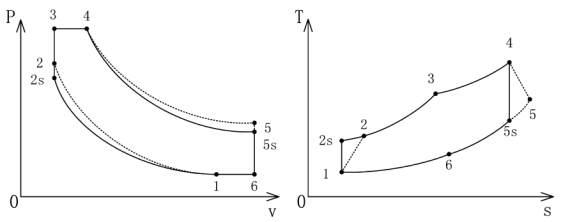
P-v and T-s diagrams of the considered irreversible air-standard DMC (1-2-3-4-5-6-1) are shown in
Figure 1.
In the diagrams, the process 1-2s is an isentropic compression, while the process 1-2 takes internal irreversibilities into account. The heat addition is done in two steps: processes 2-3 and 3-4. they are constant volume and constant pressure heat addition processes respectively. Process 3-4 also makes up the first part of the power stroke. Process 4-5s is an isentropic expansion while the process 4-5 takes into account internal irreversibilities. The heat rejection occurs in two steps: 5-6 and 6-1 are constant volume and constant pressure heat rejection processes respectively.
Figure 1. P-v and T-s diagrams for an air-standard irreversible DMC.
The design parameters of compression ratio rc, cut-off ratio ρ and Miller cycle ratio rM for the DMC are defined as follows:
 (1)
(1)  (2)
(2)  (3)
(3)  (4)
(4) According to Ref.
| [4] | C. Q. Li, Y. D. Wang, B. Jia, A. P. Roskilly, Application of Miller cycle with turbocharger and ethanol to reduce NOx and particulates emissions from diesel engine - A numerical approach with model validations, Appl. Therm. Eng. 150(2019) 904-911. https://doi.org/10.1016/j.applthermaleng.2019.01.056 |
| [34] | E. Dobrucali, The effects of the engine design and running parameters on the performance of a Otto-Miller Cycle engine, Energy 103(2016) 119-126. |
| [36] | Gonca. G, B. Sahin, Effect of turbo charging and steam injection methods on the performance of a Miller cycle diesel engine (MCDE). Appl. Therm. Eng. 118(2017) 138-146. https://doi.org/10.1016/j.applthermaleng.2017.02.039 |
[4, 34, 36]
, for the temperature range of 300 ~ 3500 K, the specific heats of air can be written as;
 (5)
(5)  (6)
(6) 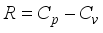 (7)
(7) where Cp- specific heat at constant pressure, Cv- specific heat at constant volume, R is gas constant and equals to 0.287 kJ/kgK, and T is the absolute temperature.
The heat added to the working fluid, during constant volume process 2→3 and constant pressure process 3-4, is expressed as
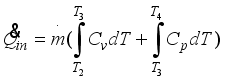 (8)
(8)  (9)
(9) where m is flow rate of working fluid, kg/s or mol/s.
The heat rejected by the working fluid, during constant volume process 5-6 and constant pressure process 6-1, is as follows
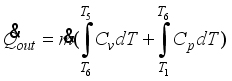 (10)
(10)  (11)
(11) Because Cp and Cv, the specific heat ratio k are dependent on temperature, the equation often used for a reversible adiabatic process with constant k cannot be used for a reversible adiabatic process with a variable k.
According to Refs.
, the equation for the reversible adiabatic process with variable specific heat can be written as
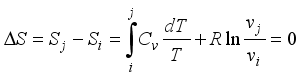 (12)
(12) During the isentropic processes 1 to 2s and 4 to 5s Eq. (
10) can be used to get a relation between T
1 and T
2s and another one between T
4 and T
5s.
Therefore, after substituting the value for Cv from Eq. (
6) and performing the integration of Eq. (
12), equations describing processes 1→2s and 4→5s can be respectively expressed as follows
 (13)
(13)  (14)
(14) The internal irreversibilities in irreversible adiabatic processes 1- 2s and 4- 5s can be defined as follows
| [41] | Z. X. Wu, L. G. Chen, Y. L. Ge, F. R. Sun, Thermodynamic optimization for an air-standard irreversible Dual-Miller cycle with linearly variable specific heat ratio of working fluid, Int. J. Heat Mass Transf 124(2018) 46-57. https://doi.org/10.1016/j.ijheatmasstransfer.2018.03.049 |
[41]
.
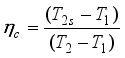 (15)
(15) 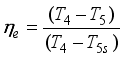 (16)
(16) where ηc and ηe are irreversible compression and expansion efficiencies, respectively, which can reflect all irreversibilities including FL for the processes 1- 2s and 4- 5s.
The heat transfer loss through the cylinder wall to the cooling medium is very complex in the actual combustion process.
Assuming that the cylinder wall temperature is constant, the heat transfer loss per second through the cylinder wall can be estimated as;
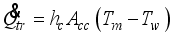 (17)
(17) where hc is a heat-transfer coefficient whose unit is W/K; and T0 is ambient temperature, K Acc is the approximate surface area of the combustion chamber, and Tm and Tw are the average cylinder gas temperature and cylinder wall temperature, respectively.
The heat transfer coefficient hc can be expressed as
| [46] | Zhao, J., Xu, F. Finite-Time Thermodynamic Modeling and a Comparative Performance Analysis for Irreversible Otto, Miller and Atkinson Cycles, Entropy 2018, 20, 75. https://doi.org/10.3390/e20010075 |
[46]
:
 (18)
(18) Here, C is a constant, P is the instantaneous pressure of the cylinder, and the average filling velocity in the W-cylinder, which is expressed as
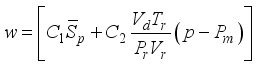 (19)
(19) In Eq. (
13), Vd is the displaced volume; p is the instantaneous cylinder pressure; and Pr, Vr, Tr are the working-fluid pressure, volume and temperature at a reference state. Pm is the motored cylinder pressure at the same crank angle as p. As shown in
Figure 1, under ideal conditions Pm is equal to P2. Select the point 2 as a reference state; and use mean incylinder pressure to substitute for the instantaneous cylinder gas pressure. Thus, these values are given as:
 (20)
(20) 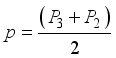 (21)
(21)  (22)
(22) 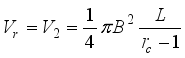 (23)
(23)  (24)
(24) From the equation of state of ideal gas, the following relation is satisfied:
 (25)
(25) The combustion chamber surface area is approximately estimated as:
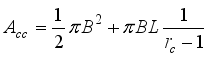 (26)
(26) For the performance analysis, including the ecological function taking into account the friction loss, we use several representative friction loss models introduced in the early study.
In the friction loss of the engine, the friction loss of the piston is the main source, and the friction loss includes boundary friction and viscous friction. According to
| [46] | Zhao, J., Xu, F. Finite-Time Thermodynamic Modeling and a Comparative Performance Analysis for Irreversible Otto, Miller and Atkinson Cycles, Entropy 2018, 20, 75. https://doi.org/10.3390/e20010075 |
[46]
, the boundary friction is mainly affected by design parameters such as maximum cylinder pressure, stroke and cylinder diameter, and viscous friction is mainly affected by the average piston speed and design parameters.
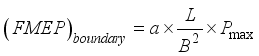 (27)
(27) where the coefficient a is multiplied to consider the influence of peak cycle pressure Pmax; and can be calibrated to include the pressure-affected friction in camshaft and crankshaft system in a real engine. The viscous piston friction under hydrodynamic lubrication conditions is primarily related with mean piston speed. The viscous piston friction is correlated by:
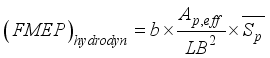 (28)
(28) where Ap, eff, is the effective area of piston skirt in contact with the cylinder liner. The coefficient b is multiplied to include speed-dependent friction in the camshaft and crankshaft system in a real engine.
Therefore, the total friction loss due to boundary friction and viscous friction (denoted by
bound-visco loss for simplicity later in the paper) output can be expressed as
| [45] | Zhao, J.; Li, Y.; Xu, F. The effects of the engine design and operation parameters on the performance of an Atkinson engine considering heat-transfer, friction, combustion efficiency and variable specific-heat. Energy Convers. Manag. 2017, 151, 11-22. https://doi.org/10.1016/j.enconman.2017.08.066 |
| [46] | Zhao, J., Xu, F. Finite-Time Thermodynamic Modeling and a Comparative Performance Analysis for Irreversible Otto, Miller and Atkinson Cycles, Entropy 2018, 20, 75. https://doi.org/10.3390/e20010075 |
[45, 46]
:
 (29)
(29) where the N is engine rotating speed and can be expressed as:
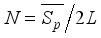 (30)
(30) The friction model of the engine was used by Chen-Flynn model
| [47] | Heywood JB. Internal combustion engine fundamentals. New York: McGraw-Hill Book Company; 1988. |
| [48] | Chen, S. K., Flynn, P. F., Development of a Single Cylinder Compression Ignition Research Engine, SAE Paper 650733, 1965. |
[47, 48]
.
The frictional loss pressure by the Chen-Flynn model is calculated as follows:
(31)
where FMEP is Friction Mean Effective Pressure, Pmax is Maximum Cylinder pressure, Speedmp is Mean Piston Speed, C is Constant part of FMEP, PF is Peak Cylinder Pressure Factor, MPSF is Mean Piston Speed Factor, MPSSF is Mean Piston Speed Squared Factor.
Another friction model is the one proposed by
, where the losses in the working process are determined by the sum of the friction losses in the intake and exhaust stroke. In this model (denoted by
in-exhaust loss  (32)
(32) where µ is friction coefficient, kg/s, L is piston stroke, m; n is cycle index per second, s-1
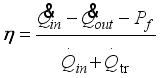
As a result, the power output can be computed as:
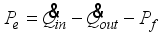 (33)
(33)  (34)
(34) The entropy generation of the DMC has four sources; HT loss, heat loss due to FL in intake and exhaust strokes, irreversible compression and expansion in compression and power strokes, and heat loss due to WF with energy exhausting to environment. According to Ref.
, the EGR due to HT loss rate is
 (35)
(35) Finally, the power loss due to FLs is transformed into heat. Such a heat loss rate is absorbed by environment totally, thus, it doesn’t have the ability to make the useful power any longer. The EGR due to the above heat loss rate can be obtained by dividing the power loss into the ambient temperature as in below.
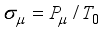 (36)
(36) in-exhaust loss;
 (37)
(37) The EGRs due to irreversible compression and expansion in compression and power strokes are
 (38)
(38)  (39)
(39) The EGR due to heat loss rate emitted into ambient medium from WF is given by
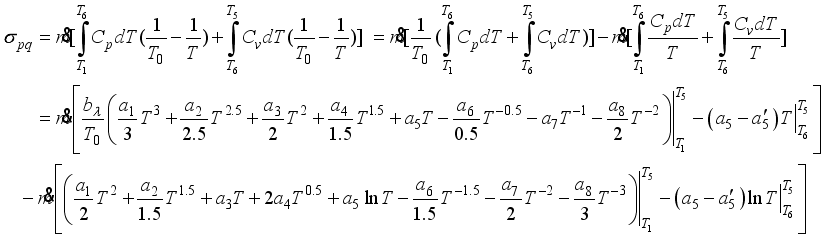 (40)
(40) Thus, the total EGR of the DMC is
 (41)
(41) The ecological function of an irreversible DMC with linearly variable SHR is expressed as
 (42)
(42) 3. Results and Discussion
An investigation has been performed on the effects of specific heat variation and heat transfer on the performance of the irreversible DMC based on the power output, thermal efficiency, and ecological function. Performance of the DMC has been compared with different specific heat models (i.e., constant, linear, and nonlinear polynomial). The effect of the design parameters such as compression ratio, pressure ratio, cut-off ratio and Miller cycle ratio on the performance of the irreversible DMC have also been investigated.
When the values of T
1, r
C, r
M, α, ρ, ηc and ηe are given, temperatures T
2s, T
2, T
3, T
5s, T
5 and T
6 can be calculated by using Eqs. (
1)-(
4)
and
(13)-(
16). Then, substituting those temperatures into Eqs. (
33), (
34) and
(42) yields P, η and E of the DMC. Assuming the ambient temperature T
0 is 300 K, the intake temperature T
1 should be higher than T
0. so
it
can be assumed to be 340~ 400 K
| [25] | Y. UST, I. OZSARI, F. ARSLAN, A. SAFA, A THEORETICAL PERFORMANCE INVESTIGATION OF IRREVERSIBLE INTERNAL COMBUSTION ENGINE NAMED AS DUAL-MILLER CYCLE Sigma J Eng & Nat Sci 38(1) (2020) 459-473. |
| [41] | Z. X. Wu, L. G. Chen, Y. L. Ge, F. R. Sun, Thermodynamic optimization for an air-standard irreversible Dual-Miller cycle with linearly variable specific heat ratio of working fluid, Int. J. Heat Mass Transf 124(2018) 46-57. https://doi.org/10.1016/j.ijheatmasstransfer.2018.03.049 |
[25, 41]
, α=7. According to Ref.
| [25] | Y. UST, I. OZSARI, F. ARSLAN, A. SAFA, A THEORETICAL PERFORMANCE INVESTIGATION OF IRREVERSIBLE INTERNAL COMBUSTION ENGINE NAMED AS DUAL-MILLER CYCLE Sigma J Eng & Nat Sci 38(1) (2020) 459-473. |
| [41] | Z. X. Wu, L. G. Chen, Y. L. Ge, F. R. Sun, Thermodynamic optimization for an air-standard irreversible Dual-Miller cycle with linearly variable specific heat ratio of working fluid, Int. J. Heat Mass Transf 124(2018) 46-57. https://doi.org/10.1016/j.ijheatmasstransfer.2018.03.049 |
[25, 41]
, the optimal r
M for MP is between 2 and 3, thus, ρ and r
M can be both taken as 1~ 4. To compare the present study with previous studies
| [41] | Z. X. Wu, L. G. Chen, Y. L. Ge, F. R. Sun, Thermodynamic optimization for an air-standard irreversible Dual-Miller cycle with linearly variable specific heat ratio of working fluid, Int. J. Heat Mass Transf 124(2018) 46-57. https://doi.org/10.1016/j.ijheatmasstransfer.2018.03.049 |
[41]
, in the calculations, the parameters are taken as; µ =1.1kg/s, L =0.06m, n=30s
-1,

.
3.1. Analysis of the Effect of Friction Models on Performance
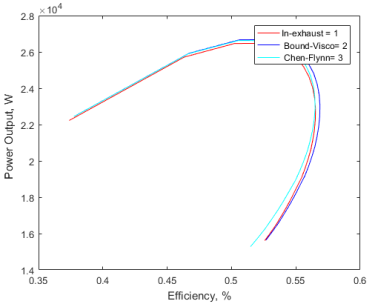
Figure 2. Results of power-efficiency calculations using different friction models.
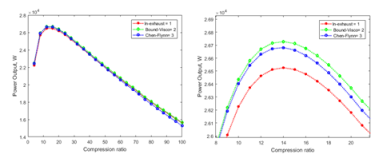
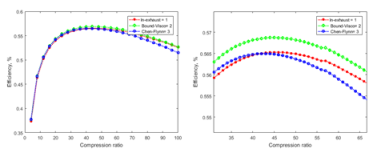
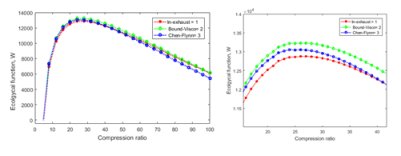
The power-efficiency relationship, compression ratio-power, compression ratio-efficiency and compression ratio-ecological function relationship using different friction models are shown in
Figures 2-4.As shown in the figure, the loss values using the in-exhaust loss model have the highest values, and in this case the optimal compression ratio values are further reduced.
It can also be seen that the performance calculation results using the boundary-viscous loss model and the Chen-Flynn model are close to 5%.
Figure 3. Results of power-compression ratio calculations using different friction models.
Figure 4. Results of thermal efficiency-compression ratio calculations using different friction models.
Figure 5. Results of ecological function-compression ratio calculations using different friction models.
In case of ρ =2, r
m =1~4, Miller cycle ratio rm, which gives the maximum power and efficiency for different friction models, is shown in
Table 1, respectively.
Table 1. Miller cycle ratio rm, which gives maximum power and efficiency.
| MP | MEF | ME |
Model 1(in-exhaust) | 2.85 | 1.99 | 2.29 |
model 2(bound-visco) | 2.85 | 1.96 | 2.28 |
model 3(Chen-Flynn) | 2.85 | 2.06 | 2.33 |
In case of ρ =2, r
m =1~4, cut-off ratio ρ, which gives the maximum power and efficiency for different friction models, is shown in
Table 2, respectively.
Table 2. Cut-off ratio ρ, which gives maximum power and efficiency.
| MP | MEF | ME |
Model 1(in-exhaust) | 2.45 | 1.55 | 1.89 |
model 2(bound-visco) | 2.45 | 1.55 | 1.89 |
model 3(Chen-Flynn) | 2.45 | 1.45 | 1.85 |
From the calculated results, it can be seen that friction loss has a significant effect on the performance loss of the cycle, but the choice of friction model has a relatively small effect on the power, efficiency and ecological function. It is also found that the increase of friction loss reduces the scope of power, efficiency, ecological function and optimum compression ratio.
As a result, it can be seen that the Chen-Flynn model is more practical due to its simplicity in calculation, reflecting the maximum pressure of the cylinder and the engine rotational speed. Hence, in Section 3.2, we consider the effect of cycle parameters on the output, efficiency and ecological function maximum using this model.
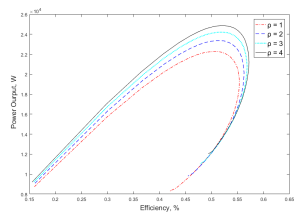
Figure 6. Effect of cut-off ratio on power-efficiency variation (Miller cycle ratio = 2).
3.2. Analysis and Performance Optimization of the Effects of Cycle Parameters and Design Parameters on Power and Efficiency
3.2.1. Analysis of the Effect of Cut-off Ratio and Miller Cycle Ratio on Power and Efficiency
Figure 6 reflects the effect of cut-off ratio on the power-efficiency variation at the Miller cycle ratio of 2.
The p-η curve has a ring shape, each curve has one point with maximum power (MP) and one point with maximum efficiency (MEF).
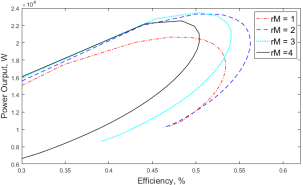
Figure 7. Effect of Miller cycle ratio on power-efficiency variation (cut-off ratio = 2).
There is a fundamental change compared to the double Miller cycle without heat loss because there is a heat transfer loss between the working fluid and the coolant.
In the region 1<ρ<4, there exist different ρ maximizing MP, MEF and ME, respectively.
Figure 7 reflects the effect of Miller cycle ratio on the power-efficiency variation when the cut-off ratio is 2. The p-η curve has a ring shape, with one point (MP) with maximum power and one point (MEF) with maximum efficiency. In the region 1<r
M<4, there exist different Miller cycle ratios that maximize MP, MEF, and ME, respectively.
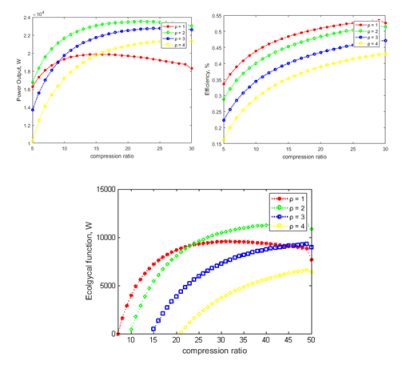
The power and efficiency variation diagram with compression ratio for fixed cut-off ratio (ρ=2) and varying Miller cycle ratio (rm=1~4) are shown in
Figure 4, respectively. With different values of Miller cycle ratio, the output power and efficiency produce a maximum peak, and as rm increases, the compression ratio, which represents the maximum power (MP) and maximum efficiency (MEF), decreases. There also exists an rm that maximizes the power and efficiency, respectively. Thus, the power and efficiency decrease when the Miller cycle ratio decreases or increases below a certain value.
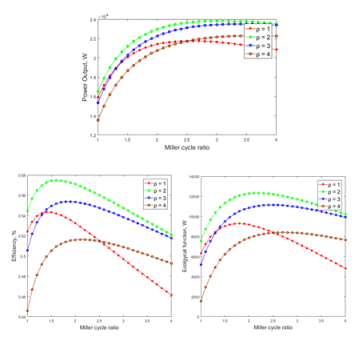
Figure 8. The effects of Miller cycle ratio on the (a) power output, (b) efficiency with compression ratio, ρ=2.
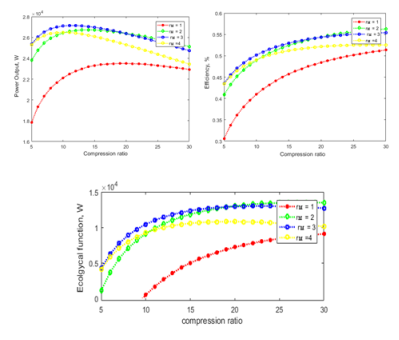
Figure 9. The effects of cut-off ratio on the (a) power output, (b) efficiency (3) ecological function with compression ratio; (rM =2).
The power and efficiency variation diagrams with compression ratio are shown in
Figure 9, respectively, for fixed Miller cycle ratio (rm=2) and variable cut-off ratio (ρ=1~4).
With different values of cut-off ratio, the power and efficiency increase and then decrease with increasing compression ratio. With increasing p, the compression ratio that gives maximum power (MP) and efficiency (MEF) increases. Also, there exists an optimal q that maximizes the power and efficiency, respectively. Thus, the power and efficiency decrease when the cut-off ratio decreases or increases below a certain value.
The above calculation results are in agreement with the calculations of
| [41] | Z. X. Wu, L. G. Chen, Y. L. Ge, F. R. Sun, Thermodynamic optimization for an air-standard irreversible Dual-Miller cycle with linearly variable specific heat ratio of working fluid, Int. J. Heat Mass Transf 124(2018) 46-57. https://doi.org/10.1016/j.ijheatmasstransfer.2018.03.049 |
[41]
.
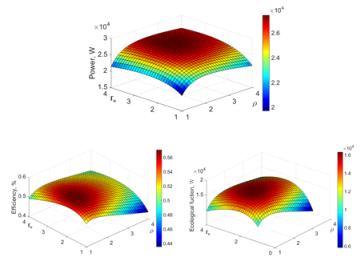
The power, efficiency and ecological function change relationship for constant compression ratio (rc = 12) and variable cut-off ratio and Miller cycle ratio are shown in
Figure 10.
Figure 10. Effect of Miller cycle ratio and cut-off ratio on power, efficiency and ecological function change (fixed compression ratio rc = 12).
3.2.2. Analysis of the Effect of Cut-off Ratio and Miller Cycle Ratio on Performance Optimization
Three-dimensional diagrams of MP and MEF versus ρ and r
M are shown in
Figure 11. Comparing Miller cycle ratio and cut-off ratio which provide maximum output power (or maximum efficiency), it can be seen from
Table 3 that Miller cycle ratio is greater than cut-off ratio ρ.
Figure 11. Effects of cut-off ratio and Miller cycle ratio on (a) MP, (b) MEF.
Table 3. Cut-off ratio and Miller cycle ratio on MP, MEF.
| MP | MEF |
cut-off ratio | 2.5 | 2 |
Miller cycle ratio | 2.85 | 2.85 |
As shown in
Table 3, it can be seen that the Miller cycle ratio that maximizes the power (efficiency) is larger than the cut-off ratio. It can also be seen that the cut-off ratio giving the ecological function maximum is between the cut-off ratio giving the power maximum and the cut-off ratio giving the efficiency maximum, and more close to the efficiency maximum.
Similarly, it can be seen that the Miller cycle ratio giving the ecological function maximum is between the Miller cycle ratio giving the power maximum and the Miller cycle ratio giving the efficiency maximum, and more closely approaches the efficiency maximum. It is well known that friction loss has a considerable effect on engine performance, but optimizing the ecological function does not affect the power output and efficiency simultaneously.
4. Conclusions
The FTT relationship for the power, efficiency and ecological functions of the dual Miller cycle considering the heat transfer change, heat transfer loss, internal irreversible loss and friction loss of the working fluid was derived and the influence of friction loss models on the performance and the relationship of the circulation parameters on the performance maximum were analyzed.
Based on the constructed FTT model, the following important conclusions were obtained:
1) It can be seen that friction loss has a significant effect on the performance loss of the cycle, but the choice of friction model has a relatively small effect on the power, efficiency and ecological function. Also, with the increase of friction loss, the scope of power, efficiency, ecological function, and optimum compression ratio is reduced.
2) There exist values of the optimum compression ratio, Miller cycle ratio and pre-expansion ratio that best improve power, power density and energy efficiency, and Miller cycle ratio that maximizes performance is greater than the pre-expansion ratio.
3) It can also be seen that the pre-expansion ratio giving the ecological function maximum is between the pre-expansion ratio giving the power maximum and the pre-expansion ratio giving the efficiency maximum. Similarly, it can be seen that the Miller cycle ratio giving the ecological function maximum is between the Miller cycle ratio giving the power maximum and the Miller cycle ratio giving the efficiency maximum, and more closely approaches the efficiency maximum.
It is expected that the models and computational results presented in this paper will be used to model the Miller cycle close to the real engine cycle and to study the cycle parameters selection and optimal design of Miller engine.
Abbreviations
B | Constant of Heat Transfer |
C | Specific Heat (kJ/kg K) |
DDC | Dual-Diesel Cycle |
DMC | Dual-Miller Cycle |
E | Ecological Function (W) |
EGR | Entropy Generation Rate |
FL | Friction Loss |
FTT | Finite Time THERMODYNAMICS |
HTL | Heat Transfer Loss |
ICE | Internal Combustion Engine |
K | Specific Heat Ratio |
L | Stroke Length (m) |
LIVC | Late Inlet Valve Closing |
MEF | Maximum Thermal Efficiency |
MP | Maximum Power Output |
MPD | Maximum Dimensionless Power Density |
m | Flow rate of Working Fluid (mol/s or kg/s) |
n | Cycle Index Per Second (s-1) |
OC | Otto Cycle |
OMC | Otto Miller Cycle |
P | Power Output (w) |
p | Pressure (pa) |
Q | Quantity of Heat Transfer (j) |
R | Gas Constant |
rc | Compression Ratio |
rM | Miller Cycle Ratio |
SH | Specific Heat |
SHR | Specific Heat Ratio |
T | Temperature (k) |
T0 | Ambient Temperature |
V | Volume (m3) |
W | Work (j) |
WF | Working Fluid |
η | Efficiency |
ηc | Isentropic Compression Efficiency |
ηe | Isentropic Expansion Efficiency |
μ | Friction Coefficient (kg/s) |
ρ | Cut-off Ratio |
σ | Entropy Generation Rate (W/K) |
α | Cycle Temperature Ratio |
in | Input |
leak | Leakage |
max | Maximum Value |
min | Minimum Value |
opt | Optimal Value |
out | Output |
pq | Effect of Working Fluid Exhausting to Environment |
q | Effect of Heat Transfer |
s | Reversible |
μ | Effect of Friction |
1; 2; 3; 4; 5; 6 | Cycle State Points |
Acknowledgments
It is also the result of collaborative research with State Academy of Sciences.
Disclosure Statement
No potential conflict of interest was reported by the author(s).
Funding
This work was partially supported by State Academy of Sciences.
Conflicts of Interest
The authors declare no conflicts of interest.
References
| [1] |
Y. L. Ge, L. G. Chen, F. R. Sun, Progress in finite time thermodynamic studies for internal combustion engine cycles, Entropy 18(4) (2016) 139.
https://doi.org/10.3390/e18040139
|
| [2] |
Ge Y, Wu H, Chen L, et al. Finite time and finite speed thermodynamic optimization for an irreversible Atkinson cycle. Energy, 2023, 270: 126856.
|
| [3] |
Andresen, B.; Salamon, P. Future perspectives of finite-time thermodynamics. Entropy 2022, 24, 690.
|
| [4] |
C. Q. Li, Y. D. Wang, B. Jia, A. P. Roskilly, Application of Miller cycle with turbocharger and ethanol to reduce NOx and particulates emissions from diesel engine - A numerical approach with model validations, Appl. Therm. Eng. 150(2019) 904-911.
https://doi.org/10.1016/j.applthermaleng.2019.01.056
|
| [5] |
Gonca. G, Thermodynamic analysis and performance maps for the irreversible Dual-Atkinson cycle engine (DACE) with considerations of temperature-dependent specific heats, heat transfer and friction losses, Energy Convers. Manage. 111(2016) 205-216.
https://doi.org/10.1016/j.enconman.2015.12.059
|
| [6] |
Wang P, Tang X, Shi L, Ni X, Hu Z, Deng K (2021) Experimental investigation of the influences of Miller cycle combined with EGR on performance, energy and exergy characteristics of a four-stroke marine regulated two-stage turbocharged diesel engine. Fuel 300, 120940.
https://doi.org/10.1016/j.fuel.2021.120940
|
| [7] |
Chen, L., Zhu, F., Shi, S. et al. Power and efficiency optimizations of Maisotsenko-Atkinson, Dual and Miller cycles and performance comparisons with corresponding traditional cycles. Sci. China Technol. Sci. 66, 3393-3411 (2023).
https://doi.org/10.1007/s11431-023-2444-1
|
| [8] |
Zang, P. C.; Chen, L. G.; Ge, Y. L.; Shi, S. S. Four-objective optimization for an irreversible porous medium cycle with linear variation in working fluid’s specific heat. Entropy 2022, 24, 1074.
|
| [9] |
Ahmadi, M. H.; Pourkiaei, S. M.; Ghazvini, M.; Pourfayaz, F. Thermodynamic assessment and optimization of performance of irreversible Atkinson cycle. Iran. J. Chem. Chem. Eng. 2020, 39, 267-280.
|
| [10] |
Georgiou C, Azimov U (2020) Analysis and multi-parametric optimisation of the performance and exhaust gas emissions of a heavy-duty diesel engine operating on miller cycle. Energies 13(14): 3724.
https://doi.org/10.3390/en13143724
|
| [11] |
Zerom M, Gonca. G (2020) Multi-criteria performance analysis of dual miller cycle-Organic rankine cycle combined power plant. Energy Conversion Management 221, 113121.
https://doi.org/10.1016/j.enconman.2020.113121
|
| [12] |
Shengli Wei, Chengcheng Wu, Shuzhe Yan, Tongyuan Ding, Jie Chen (2022). Miller Cycle with Early Intake Valve Closing in Marine Medium-Speed Diesel Engines. Journal of Marine Science and Application, 21(1): 151-160.
https://doi.org/10.1007/s11804-022-00250-5
|
| [13] |
Ge, Y.; Chen, L.; Sun, F. Performance of an Atkinson cycle with heat transfer, friction and variable specific-heats of the working fluid. Appl. Energy 2006, 83, 1210-1221.
https://doi.org/10.1016/j.apenergy.2005.12.003
|
| [14] |
Y. R. Zhao, J. C. Chen, Performance analysis of an irreversible Miller heat engine and its optimum criteria, Appl. Therm. Eng. 27(11-12) (2007) 2051-2058.
https://doi.org/10.1016/j.applthermaleng.2006.12.002
|
| [15] |
A. Mousapour and M. M. Rashidi, Performance Evaluation of an Air-Standard Miller Cycle with Consideration of Heat Losses, International Journal of Mechatronics, Electrical and Computer Technology, Vol. 4(12) (2014) 1175-1191.
|
| [16] |
Gonca. G, Sahin. B, Ust. Y, Performance maps for an air-standard irreversible Dual-Miller cycle (DMC) with late inlet valve closing (LIVC) version, Energy 54(2013) 285-290.
https://doi.org/10.1016/j.energy.2013.02.004
|
| [17] |
Y. Ust, F. Arslan, I. Ozsari, M. Cakir, Thermodynamic performance analysis and optimization of DMC (Dual Miller Cycle) cogeneration system by considering exergetic performance coefficient and total exergy output criteria, Energy 90(2015) 552-559.
https://doi.org/10.1016/j.energy.2015.07.081
|
| [18] |
Gonca. G, Sahin. B, Ust. Y, Parlak. A, Comprehensive performance analyses and optimization of the irreversible thermodynamic cycle engines (TCE) under maximum power (MP) and maximum power density (MPD) conditions. Appl. Therm. Eng. 85(2015) 9-20.
https://doi.org/10.1016/j.applthermaleng.2015.02.041
|
| [19] |
Gonca. G, Sahin. B, Ust. Y, Investigation of Heat Transfer Influences on Performance of Air-Standard Irreversible Dual-Miller Cycle. Journal of Thermophysics and Heat Transfer 29(2015) 678-693.
https://doi.org/10.2514/1.T4512
|
| [20] |
M. CAKIR, THE NUMERICAL THERMODYNAMIC ANALYSIS OF OTTO-MILLER CYCLE, THERMAL SCIENCE: 20(2016) 363-369.
https://doi.org/10.2298/TSCI150623131C
|
| [21] |
Gonca. G, Sahin. B, Thermo-ecological performance analyses and optimizations of irreversible gas cycle engines, Appl. Therm. Eng. 105(2016) 566-576.
https://doi.org/10.1016/j.applthermaleng.2016.03.046
|
| [22] |
Gonca. G, Comparative performance analyses of irreversible OMCE (Otto Miller cycle engine)-DiMCE (Diesel miller cycle engine)-DMCE (Dual Miller cycle engine), Energy 109(2016) 152-159.
https://doi.org/10.1016/j.energy.2016.04.049
|
| [23] |
R. Ebrahimi, A new design method for maximizing the work output of cycles in reciprocating internal combustion engines, Energy Convers. Manage. 172(2018) 164-172.
https://doi.org/10.1016/j.enconman.2018.07.029
|
| [24] |
Z. X. Wu, L. G. Chen, H. J. Feng, Thermodynamic Optimization for an Endoreversible Dual-Miller Cycle (DMC) with Finite Speed of Piston, Entropy 20(2018) 165.
https://doi.org/10.3390/e20030165
|
| [25] |
Y. UST, I. OZSARI, F. ARSLAN, A. SAFA, A THEORETICAL PERFORMANCE INVESTIGATION OF IRREVERSIBLE INTERNAL COMBUSTION ENGINE NAMED AS DUAL-MILLER CYCLE Sigma J Eng & Nat Sci 38(1) (2020) 459-473.
|
| [26] |
J. You, L. G. Chen, Z. X. Wu, F. R. Sun, Thermodynamic performance of DualMiller cycle (DMC) with polytropic processes based on power output, thermal efficiency and ecological function, Sci. China: Tech. Sci. 61(3) (2018) 453-463.
|
| [27] |
S. Abedinnezhad, M. H. Ahmadi, S. M. Pourkiaei, F. Pourfayaz, A. Mosavi, M. Feidt, S. Shamshirband, Thermodynamic Assessment and Multi-Objective Optimization of Performance of Irreversible Dual-Miller Cycle, Energies 12(4000) (2019) 1-25.
|
| [28] |
A. Al-Sarkhi, J. Jaber, S. Probert, Efficiency of a Miller engine, Appl. Energ. 83(4) (2006) 343-351.
https://doi.org/10.1016/j.apenergy.2005.04.003
|
| [29] |
A. Al-Sarkhi, I. Al-Hinti, E. Abu-Nada, B. Akash, Performance evaluation of irreversible Miller engine under various specific heat models, Int. Comm. Heat Mass Transfer 34(7) (2007) 897-906.
https://doi.org/10.1016/j.icheatmasstransfer.2007.03.012
|
| [30] |
J. C. Lin, S. S. Hou, Performance analysis of an air-standard Miller cycle with considerations of heat loss as a percentage of fuel's energy, friction and variable specific heats of working fluid, Int. J. Therm. Sci. 47(2) (2008) 182-191.
|
| [31] |
X. M. YE, Effect of variable heat capacities on performance of an irreversible Miller heat engine, Energy. 6(3) (2012) 280-284.
|
| [32] |
R. Ebrahimi, M. Hoseinpour, Performance Analysis of Irreversible Miller Cycle Under Variable Compression Ratio, JOURNAL OF THERMOPHYSICS AND HEAT TRANSFER 27(3) (2013)542-548.
|
| [33] |
J. M. Lin, Z. P. Xu, S. Q. Chang, H. Yan, Finite-time thermodynamic modelling and analysis of an irreversible Miller cycle working on a four-stroke engine, Int. Comm. Heat Mass Transfer 54(2014) 54-59.
https://doi.org/10.1016/j.icheatmasstransfer.2014.03.012
|
| [34] |
E. Dobrucali, The effects of the engine design and running parameters on the performance of a Otto-Miller Cycle engine, Energy 103(2016) 119-126.
|
| [35] |
G. Gonca, AN OPTIMIZATION STUDY ON AN ECO-FRIENDLY ENGINE CYCLE NAMED AS DUAL-MILLER CYCLE (DMC) FOR MARINE VEHICLES, POLISH MARITIME RESEARCH 24(2017) 86-98.
|
| [36] |
Gonca. G, B. Sahin, Effect of turbo charging and steam injection methods on the performance of a Miller cycle diesel engine (MCDE). Appl. Therm. Eng. 118(2017) 138-146.
https://doi.org/10.1016/j.applthermaleng.2017.02.039
|
| [37] |
Y. L. Ge, L. G. Chen, X. Y. Qin, Effect of specific heat variations on irreversible Otto cycle performance, Int. J. Heat Mass Transf 122(2018) 403-409.
https://doi.org/10.1016/j.ijheatmasstransfer.2018.01.132
|
| [38] |
R. Ebrahimi, Thermodynamic modeling of performance of a Miller cycle with engine speed and variable specific heat ratio of working fluid, Comput. Math. Appl. 62(5) (2011) 2169-2176.
|
| [39] |
Z. J. Yan, Comment on ‘‘ecological optimization criterion for finite-time heat engines”, J. Appl. Phys. 73(7) (1993) 3583.
|
| [40] |
Gonca. G, Thermo-ecological analysis of irreversible Dual-Miller cycle (DMC) engine based on the ecological coefficient of performance (ECOP) criterion, Iran. J. Sci. Technol. Trans. Mech. Eng. 41(4) (2017) 269-280.
|
| [41] |
Z. X. Wu, L. G. Chen, Y. L. Ge, F. R. Sun, Thermodynamic optimization for an air-standard irreversible Dual-Miller cycle with linearly variable specific heat ratio of working fluid, Int. J. Heat Mass Transf 124(2018) 46-57.
https://doi.org/10.1016/j.ijheatmasstransfer.2018.03.049
|
| [42] |
Z. X. Wu, L. G. Chen, Y. L. Ge, F. R. Sun, Power, efficiency, ecological function and ecological coefficient of performance of an irreversible Dual-Miller cycle (DMC) with nonlinear variable specific heat ratio of working fluid, Eur. Phys. J. Plus 132(5) (2017) 203.
|
| [43] |
L. G. Chen, Y. L. Ge, C. Liu, H. J. Feng, G. L. Lorenzini, Performance of Universal Reciprocating Heat-Engine Cycle with Variable Specific Heats Ratio of Working Fluid, Entropy 22(397) (2020) 1-13.
https://doi.org/10.3390/e22040397
|
| [44] |
Gonca. G., Hocaoglu, M. F. Performance Analysis and Simulation of a Diesel-Miller Cycle (DiMC) Engine. Arab J Sci Eng 44, 5811-5824 (2019).
https://doi.org/10.1007/s13369-019-03747-4
|
| [45] |
Zhao, J.; Li, Y.; Xu, F. The effects of the engine design and operation parameters on the performance of an Atkinson engine considering heat-transfer, friction, combustion efficiency and variable specific-heat. Energy Convers. Manag. 2017, 151, 11-22.
https://doi.org/10.1016/j.enconman.2017.08.066
|
| [46] |
Zhao, J., Xu, F. Finite-Time Thermodynamic Modeling and a Comparative Performance Analysis for Irreversible Otto, Miller and Atkinson Cycles, Entropy 2018, 20, 75.
https://doi.org/10.3390/e20010075
|
| [47] |
Heywood JB. Internal combustion engine fundamentals. New York: McGraw-Hill Book Company; 1988.
|
| [48] |
Chen, S. K., Flynn, P. F., Development of a Single Cylinder Compression Ignition Research Engine, SAE Paper 650733, 1965.
|
Cite This Article
-
APA Style
Choe, K. S., Min, Y. J., Ri, S. D., Ri, M. C. (2025). Effects of Friction Loss Models and Cycle Parameters on the Performance of the Irreversible Dual-Miller Cycle. International Journal of Fluid Mechanics & Thermal Sciences, 11(3), 33-49. https://doi.org/10.11648/j.ijfmts.20251103.11
 Copy
|
Copy
|
 Download
ACS Style
Choe, K. S.; Min, Y. J.; Ri, S. D.; Ri, M. C. Effects of Friction Loss Models and Cycle Parameters on the Performance of the Irreversible Dual-Miller Cycle. Int. J. Fluid Mech. Therm. Sci. 2025, 11(3), 33-49. doi: 10.11648/j.ijfmts.20251103.11
Copy
|
Download
AMA Style
Choe KS, Min YJ, Ri SD, Ri MC. Effects of Friction Loss Models and Cycle Parameters on the Performance of the Irreversible Dual-Miller Cycle. Int J Fluid Mech Therm Sci. 2025;11(3):33-49. doi: 10.11648/j.ijfmts.20251103.11
Copy
|
Download
-
@article{10.11648/j.ijfmts.20251103.11,
  author = {Kum Song Choe and Yong Jae Min and Sang Dok Ri and Myong Chol Ri},
  title = {Effects of Friction Loss Models and Cycle Parameters on the Performance of the Irreversible Dual-Miller Cycle
},
  journal = {International Journal of Fluid Mechanics & Thermal Sciences},
  volume = {11},
  number = {3},
  pages = {33-49},
  doi = {10.11648/j.ijfmts.20251103.11},
  url = {https://doi.org/10.11648/j.ijfmts.20251103.11},
  eprint = {https://article.sciencepublishinggroup.com/pdf/10.11648.j.ijfmts.20251103.11},
  abstract = {Since the effects of various irreversible losses and cycle conditions on the internal combustion engine performance are significant, it is important to compare the effects of the parameters on the performance in a cycle study. Thermodynamic cycle studies should take into account the irreversible losses such as internal irreversibility, friction losses, heat transfer losses, and the variation of the specific heat of the working fluid. This study aims at deriving the analytic equation with respect to ecological function of the irreversible Dual-Miller cycle (DMC) by using the specific heat model of polynomial, and comparing results of performance calculation of different friction losses, and analyzing the effect of the cycle parameters for optimum performance. The calculation results show that the friction loss has a considerable influence on the engine performance, but there is no significant difference in the choice of the cycle parameters for optimum performance. It is also found that optimizing the ecological function is an effective way to simultaneously increase the power and efficiency, and the friction loss is not affected. The cut-off ratio, which gives the ecological function maximum, is between the cut-off ratio, which gives the power and efficiency maximum, and the Miller cycle ratio, respectively, which is closer to the efficiency maximum. The Miller cycle ratio that maximizes performance is slightly larger than the cut-off ratio. The presented models and results are expected to provide guidelines for the design and optimization of DMC engines, and for the performance improvement and to perform the cycle modeling close to the cycle of the actual engine.},
 year = {2025}
}
Copy
|
Download
-
TY  - JOUR
T1  - Effects of Friction Loss Models and Cycle Parameters on the Performance of the Irreversible Dual-Miller Cycle

AU  - Kum Song Choe
AU  - Yong Jae Min
AU  - Sang Dok Ri
AU  - Myong Chol Ri
Y1  - 2025/08/25
PY  - 2025
N1  - https://doi.org/10.11648/j.ijfmts.20251103.11
DO  - 10.11648/j.ijfmts.20251103.11
T2  - International Journal of Fluid Mechanics & Thermal Sciences
JF  - International Journal of Fluid Mechanics & Thermal Sciences
JO  - International Journal of Fluid Mechanics & Thermal Sciences
SP  - 33
EP  - 49
PB  - Science Publishing Group
SN  - 2469-8113
UR  - https://doi.org/10.11648/j.ijfmts.20251103.11
AB  - Since the effects of various irreversible losses and cycle conditions on the internal combustion engine performance are significant, it is important to compare the effects of the parameters on the performance in a cycle study. Thermodynamic cycle studies should take into account the irreversible losses such as internal irreversibility, friction losses, heat transfer losses, and the variation of the specific heat of the working fluid. This study aims at deriving the analytic equation with respect to ecological function of the irreversible Dual-Miller cycle (DMC) by using the specific heat model of polynomial, and comparing results of performance calculation of different friction losses, and analyzing the effect of the cycle parameters for optimum performance. The calculation results show that the friction loss has a considerable influence on the engine performance, but there is no significant difference in the choice of the cycle parameters for optimum performance. It is also found that optimizing the ecological function is an effective way to simultaneously increase the power and efficiency, and the friction loss is not affected. The cut-off ratio, which gives the ecological function maximum, is between the cut-off ratio, which gives the power and efficiency maximum, and the Miller cycle ratio, respectively, which is closer to the efficiency maximum. The Miller cycle ratio that maximizes performance is slightly larger than the cut-off ratio. The presented models and results are expected to provide guidelines for the design and optimization of DMC engines, and for the performance improvement and to perform the cycle modeling close to the cycle of the actual engine.
VL  - 11
IS  - 3
ER  -
Copy
|
Download




 Share This Article
 Twitter
 Linked In
 Facebook