This study numerically explores natural convection in a trapezoidal enclosure with a wavy upper boundary and a centrally placed circular cavity of varying radius. The left vertical wall is maintained at a low temperature, while the right wall is heated. The remaining boundaries are adiabatic. Three obstacle sizes are considered with radius 0.05, 0.08 and 0.03 representing different levels of geometric blockage. Simulations are carried out in COMSOL Multiphysics for Rayleigh numbers between 103 and 106 under the Boussinesq approximation. Flow circulation temperature contours and heat transfer performance are analyzed for each configuration. The results indicate that enlarging the circular cavity alters the strength and structure of buoyancy-driven vortices, influencing thermal stratification and the effective heat transfer rate across the cavity. At low Rayleigh numbers conduction dominates and influence of cavity size limited whereas at higher Rayleigh numbers natural convection becomes significant and the obstacle radius strongly affects vortex dynamics and Nusselt number distribution. The findings provide insight into the coupled effect of cavity geometry and buoyancy intensity offering guidance for the design of thermal system with internal obstacles and irregular enclosures. The main objective of this paper is to find out the effect of natural convection of air within a wavy chamber using finite element methods and to investigate the influence of heated wall on free convection flow numerically.
This is an Open Access article, distributed under the terms of the Creative Commons Attribution 4.0 International License (http://creativecommons.org/licenses/by/4.0/), which permits unrestricted use, distribution and reproduction in any medium or format, provided the original work is properly cited.
Nowadays in this world improving the heat transfer rate in different field such as electrical engineering, mechanical engineering, solar collectors, biomedical etc. is an interesting and valuable project. So a large number of researcher have tried to improve the heat transfer rate in different technique. From them Hammoodi
[1]
Hammoodi M. A., & Al-Sulaiman, F. A. et al “A Comprehensive Review on Natural Convection in Trapezoidal Cavities”. International Journal of Fluid Mechanics. Volume: 27, Article id / page: 101226. (May 2025)
showed that synthesizes advancement in natural convection within trapezoidal cavities using mono and hybrid nanofluids emphasizing their geometric advantages for thermal management. Baytaş, A. C
[2]
Baytas, A. C., & Pop et al.” Heatline Visualization of Natural Convection Flows within Trapezoidal Cavities”. International Journal of Heat and Mass Transfer, *26*(8), 1139–1148. (1999)
investigated that laminar natural convection flow in trapezoidal enclosures to study the influence of the inclination angle on the flow and also the dependence of the average Nusselt number on the Rayleigh number. De Vahl Davis
[3]
De Vahl Davis, G. “Natural Convection of Air in a Square Cavity: a Bench Mark Numerical Solution.” International Journal for Numerical Methods in Fluids, 3, 249-264. (1983)
investigated that natural convection in a square cavity using numerical methods to solve the Navier-Stokes and energy equations which provides benchmark solutions for validating computational fluid dynamics (CFD) models. Esfe, M. H et al
[4]
Esfe, M. H., & Chamkha, A. J.” Numerical Simulation of Thermal Radiation Influence on Natural Convection in Trapezoidal Enclosures.” Journal: International Journal of Heat and Mass Transfer’ *145*, 118783. (2019)
studied on Numerical Simulation of Thermal Radiation Influence on Natural Convection in Trapezoidal Enclosures and found that a theoretical and numerical study of natural convection in two-dimensional laminar incompressible flow in a trapezoidal enclosure in the presence of thermal radiation is conducted, motivated by energy systems applications. Mahapatra
[5]
Mahapatra, T. R., & Saha, B. C. “Natural Convection in a Cavity with Trapezoidal Heat Sources Mounted on the Bottom Wall” Journal: SN Applied Sciences, 2, 1722 (2020).
studied the effect of the Rayleigh number on the Nusselt number at the top of a heat source and at the outer walls of the cavity. Hussein
[6]
Hussein, H. A” Finite Volume Simulation of Natural Convection in a Trapezoidal Cavity” Journal: University of Babylon Journal of Fluid Mechanics *10*, 1-9(2013).
[6]
described about numerical results for natural convection heat transfer in partially divided trapezoidal cavities investigating the effects of Rayleigh number, Prandtl number, baffle height and baffle location on the heat transfer. Teamah
[7]
M. A., & Shehata, A. I.” Natural Convection Inside a Trapezoidal Cavity Under Multidirectional Magnetic Impacts” Journal: Alexandria Engineering Journal. *61*(11), 8923-8936. (2022)
provided a detailed understanding of the fluid flow and heat transfer characteristics inside the trapezoidal cavity under the influence of multidirectional magnetic impacts. Basak
[8]
Basak, T., & Pop, I. “Magnetohydrodynamic Natural Convection in Trapezoidal Cavities” Journal: International Journal of Thermal Sciences, *129*, 172-188. (2018)
examined magnetohydrodynamic natural convection heat transfer inside a trapezoidal enclosure for different Hartmann number, Rayleigh number and inclination angle of inclined walls. Lasfer
[9]
Lasfer, M., & Oztop, H. F. “Numerical Study of Laminar Natural Convection in a Side-Heated Trapezoidal Cavity at Various Inclined Heated Sidewalls” Journal: WSEAS Transactions on Heat and Mass Transfer. *4*(4), 91-100. (2009)
[9]
discussed about Numerical Study of Laminar Natural Convection in a Side-Heated Trapezoidal Cavity at Various Inclined Heated Sidewalls. This numerical study investigated laminar natural convection in a side-heated trapezoidal cavity at various inclined heated sidewalls. Hasan
[10]
Hasan, M., & Mahmud, M. A. “Natural Convection Inside a Porous Trapezoidal Enclosure with Wavy Top Surface” Journal: AIP Conference Proceedings. *2121*(1), 030005(2019)
analyzed heat flow during natural convection inside a trapezoidal porous cavity having a wavy top surface. Esfe
[11]
Esfe, M. H., & Chamkha ”Simulation of Natural Convection Heat Transfer in a 2-D Trapezoidal Enclosure” Journal: International Journal of Thermofluids. *21*, 100614.9(2024)
Simulated on Natural Convection Heat Transfer in a 2D Trapezoidal Enclosure where he found that numerical results are validated with previous results. The governing parameters namely Rayleigh number and Prandtl number on flow patterns isotherms as well as local Nusselt number are reported. Mahapatra
[12]
Mahapatra, T. R., & Saha, B. C. “Natural Convection Inside a Trapezoidal Cavity with Nanofluid and Magnetic Field” Journal: Journal of Thermal Analysis and Calorimetry. *143*(1), 687–703(2021).
considered the natural convection in a 3D trapezoidal cavity filled with Al2O3-water nanofluid. The left and right vertical cavity walls were maintained at different hot and cold temperatures. Mirzaei, Amirmohammad, et al
[13]
Mirzaei, Amirmohammad, et al. "Convection heat transfer of MHD fluid flow in the circular cavity with various obstacles: Finite element approach." International journal of thermofluids 20 (2023).
investigated fluid flow and heat transfer in a circular cavity with a variable number of obstacles in each step. U Rashid et al
[14]
Rashid, Umair, Dianchen Lu, and Quaid Iqbal. "Nanoparticles impacts on natural convection nanofluid flow and heat transfer inside a square cavity with fixed a circular obstacle." Case Studies in Thermal Engineering 44 (2023): 102829.
investigated the influence of nanoparticle shape on nanofluid flow within a lid-driven square cavity containing a fixed circular obstacle at its center. The top wall of the cavity is adiabatic and in motion, while the circular obstacle and the bottom wall are heated, and the remaining walls are maintained at a cold temperature. Hossain, M.S et al
[15]
Hossain, M. S., Alim, M. A. & Andallah, L.S. Numerical Simulation of MHD Natural Convection Flow Within Porous Trapezoidal Cavity With Heated Triangular Obstacle. Int. J. Appl. Comput. Math 6, 166 (2020).
M. S. Hossain investigated a steady, laminar, two-dimensional magnetohydrodynamic (MHD) natural convective flow within a porous medium-filled trapezoidal cavity containing a heated triangular obstacle of varying aspect ratios.
The main objective of this study is to numerically investigate the effect of varying the inner circular obstacle radius on natural convection heat transfer inside a trapezoidal cavity using COMSOL Multiphysics. The cavity is subjected to differential wall heating with the left wall maintained at high temperature and the right wall kept cold. Simulations are carried out for Rayleigh numbers ranging from and and obstacle radius of 0.05, 0.1 and 0.2 in order to analyze the resulting flow circulation, temperature distribution and heat transfer characteristics.
2. Physical Model
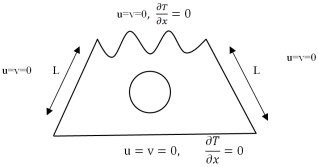
Here the Figure 1 shows the schematic problem domain of natural convection of fluid flow in Trapezoidal shape filled with air. The left wall of the figure is kept constant hot temperature () and the right wall is taken as an constant cold temperature () and the others are adiabatic. In this cavity heat source’s geometry, location and size play an important role for improving the heat transfer rate. Here we thought 2D incompressible fluid flow where we also have taken a circle inside the cavity. The enclose length is considered L. The acceleration due to gravity acts in the negative y -direction. For all solid boundaries, no slip walls are considered.
Figure 1. The physical configuration of the cavity.
2.1. Mathematical Formulation
The left and right wall are maintained at different constant temperatures to induce natural convection while the top and bottom walls are assumed adiabatic. The governing equations for laminar, incompressible, and steady-state natural convection based on the Navier–Stokes and energy equations with the Boussinesq approximation are solved in a dimensionless form. The Boussinesq approximation is employed to model buoyancy-driven natural convection within the trapezoidal cavity. Under this approximation density is considered constant throughout the fluid domain except in the buoyancy term of the momentum equations, where it is treated as a linear function of temperature.
(1)
)(2)
(3)
Here some dimensionless variables are that are used in (1-3) to convert the equation into dimensionless
,,,,(4)
2.2. Boundary Conditions of the Problem
On the left wall:
On top(wavy) and bottom walls:
On right wall:
Putting the boundary condition and dimensionless variables into (1-3) we get the dimensionless equation:
(5)
(6)
(7)
Now the dimensionless quantity is
,
2.3. Nusselt Number
The rate of heat transfer by convection in an encloser is calculated by the Nusselt number (Nu) and the local Nusselt number () is calculated at the fin walls by
Where h is the heat transfer coefficient, n is the normal direction on the surface (a negative sign refers to the heat transfer from the hot wall to the field). The dimensionless normal temperature gradient can be written as
Therefore, the average Nusselt number for the heated fin of the square cavity surface is defined as:
.
Where, S is the total chord length of the heated fin and s is the coordinate along the fin surface.
3. Methodology
The governing equations of incompressible laminar flow and heat transfer were solved using the finite element method under the Boussinesq approximation. A trapezoidal cavity with a centrally placed circular obstacle is considered where the left and right walls are maintained at hot and cold temperature respectively. And the upper wavy wall, based wall and obstacle are considered as adiabatic. Simulations are performed by COMSOL multiphysics for Rayleigh numbers between and and obstacle radius of 0.05, 0.1 and 0.2 times the cavity length. After discretization of the governing equations the system becomes nonlinear. To obtain accurate solutions the Newton-Raphson iteration method is employed. In this approach the solution is update iteratively until the residuals fall below the prescribed convergence tolerance. This method ensures numerical stability and accuracy for the wide range of Rayleigh numbers considered. The computational mesh is refined near solid boundaries to capture thermal and velocity gradients and grid independence tests are carried out. Key outputs included temperature contours, streamline patterns and local and average nusselt numbers to evaluate the influence of obstacle size on natural convection heat transfer.
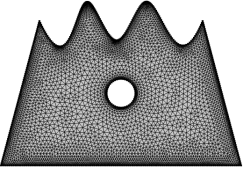
For the Grid Independent Test we used .Near the boundary layer we used Fine for the first case, Extra fine mesh for second cases and extremely fine for last case. The test results are given in the table blew:
Table 1. The mesh validation.
Name
Number of Mesh
Average Nusselt Number
Error
Fine
4567
0.90942
0.003
Finer
8540
0.90639
0.001
Extra Fine
22205
0.90517
-
Here we use finer mesh for the computational work.
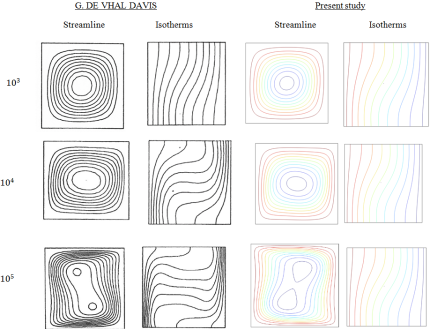
To prove the reliability of the model we have to compare it with a published literature. The simulation result of this present model has been compared with De Vahl Davis
[3]
De Vahl Davis, G. “Natural Convection of Air in a Square Cavity: a Bench Mark Numerical Solution.” International Journal for Numerical Methods in Fluids, 3, 249-264. (1983)
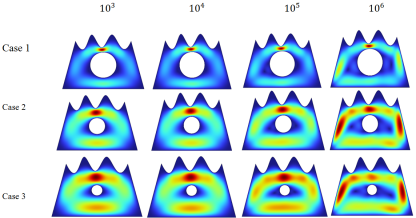
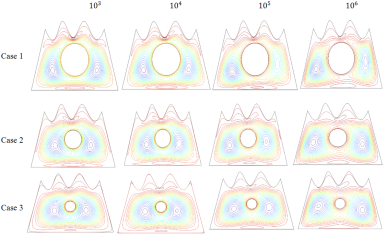
Figure 4. Velocity distribution for different Rayleigh number and inner circle radius.
1) Low Ra(: The velocity field shows weak fluid motion across all cases as thermal conduction is dominant. Only small recirculation form around the obstacle.
2) Moderate Ra(The velocity magnitude increases significantly. Stronger circulation cells appear especially in case 2 and case 3 where the obstacle forces fluid to accelerate around it.
3) High Ra(Velocity contours indicate strong upward.
4) and downward jets near the hot and cold walls. Case 3 exhibits the highest intensity as the longer obstacle constrains the flow and enhances circulation around it leading to stronger velocity gradients.
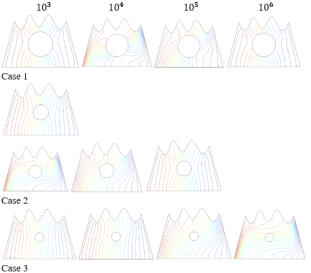
Figure 5. Streamline distribution for different Rayleigh number and inner circle radius.
Case 1(large obstacle): The larger radius significantly modifies the streamline pattern. At higher Ra strong recirculation zones are formed around the obstacle promoting more vigorous convection. This case demonstrates the most complex flow field.
Case 2(medium obstacle): The streamlines are more distorted compared to case 3. Secondary circulation cells appear around the obstacle especially at Ra= and including enhanced convective mixing.
Case 3(small obstacle): Streamline show a single dominant circulation cell at lower Ra which becomes more complex at Ra=. The flow bypasses the small obstacle easily causing moderate disturbance.
Figure 6. Isotherms distribution for different Rayleigh number and inner circle radius.
Low Ra(:Isotherms are nearly vertical and evenly spaced indicating conduction dominated heat transfer. The presence of the obstacle only slightly disturbs the thermal field.
Moderate Ra(:Isotherms begin to bend and cluster near the hot and cold walls showing the increasing influence of convection. Around the obstacle distortion of isotherms becomes evident particularly in cases 2 and 3.
High Ra( Strong convection leads to significant isotherm clustering near the vertical walls indicating intense heat transfer. In case 3 the distortion is maximum as the large obstacle enhances circulation and thermal mixing.
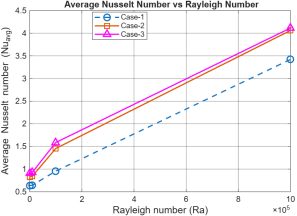
Now the average Nusselt number distribution of this three cases between the Rayleigh number (-):
Table 2. The table of all Average Nusselt number varying Rayleigh number and obstacle size.
Figure 7. Average Nusselt number for the different cases.
4. Conclusion
This numerical study investigated the influence of a circular obstacle’s radius on natural convection heat transfer within a trapezoidal cavity across a range of Rayleigh numbers(Ra) from Three distinct obstacle radius were analyzed: Case 1(R=0.08), Case 2(R=0.05), Case 3(R=0.03). The findings are summarized as follows:
1) Enhanced Heat Transfer with Smaller Obstacles: The results demonstrate a clear correlation between the obstacle size and average Nusselt number (Nu_avg), the key metric for heat transfer performance. For all Rayleigh number studied Case 3 consistently yielded the highest Nu_avg followed by Case 2 and then Case 1. This indicates that a smaller obstacle presents less resistance to the convective flow allowing for more efficient thermal plumes as visually confirmed by the isotherm distributions in Figure 6.
2) Rayleigh Number Dominance at High Intensities: The impact of the obstacle size is most pronounced in the conduction dominated (Ra=) and early convection regimes (Ra= where the relative differences between cases are significant. However at the highest Rayleigh number () the Nu_avg values for all three cases converge to a much closer range. This suggests that while the obstacle size is critical design parameter its relative influence is mitigated by the overwhelming strength of buoyancy driven flows at very high Ra where the flow dynamics become increasingly turbulent.
In conclusion this work establishes that minimizing the size of an internal obstacle in an effective strategy for enhancing natural convection heat transfer. Here we can see that for small circle the velocity is increasing because there have much place to spread the temparature as case 3. On the Other hand there have low velocity when the circle radius will increasing as case 1. The optimal design for a system operating across a wide range of thermal intensities would incorporate the smallest feasible obstacle size to minimize flow obstruction thereby leveraging the full potential of buoyancy driven convection.
Abbreviations
CFD
ComputationalFluidDynamics
Acceleration of Gravitation
Thermal Conductivity
Cavity Length
Average Nusselt Number
Dimensional Pressure
Non-dimensional Pressure
Prandtl Number
Rayleigh Number
Fluid Temperature
Dimensional Velocity Component
Non-dimensional Velocity Component
Dimensional Coordinates
Non-dimensional Coordinates
Thermal Diffusivity
Thermal Expansion Coefficient
Stream Function
Non-dimensional Temperature
Density
Electric Conductivity
Author Contributions
Abdullah Ahmed Foisal: Formal Analysis, Methodology, Supervision, Validation, Writing – original draft, Writing – review & editing
Akimul Islam Saikat: Conceptualization, Formal Analysis, Investigation, Methodology, Software, Validation, Visualization, Writing – original draft, Writing – review & editing
Hammoodi M. A., & Al-Sulaiman, F. A. et al “A Comprehensive Review on Natural Convection in Trapezoidal Cavities”. International Journal of Fluid Mechanics. Volume: 27, Article id / page: 101226. (May 2025)
Baytas, A. C., & Pop et al.” Heatline Visualization of Natural Convection Flows within Trapezoidal Cavities”. International Journal of Heat and Mass Transfer, *26*(8), 1139–1148. (1999)
De Vahl Davis, G. “Natural Convection of Air in a Square Cavity: a Bench Mark Numerical Solution.” International Journal for Numerical Methods in Fluids, 3, 249-264. (1983)
Esfe, M. H., & Chamkha, A. J.” Numerical Simulation of Thermal Radiation Influence on Natural Convection in Trapezoidal Enclosures.” Journal: International Journal of Heat and Mass Transfer’ *145*, 118783. (2019)
Mahapatra, T. R., & Saha, B. C. “Natural Convection in a Cavity with Trapezoidal Heat Sources Mounted on the Bottom Wall” Journal: SN Applied Sciences, 2, 1722 (2020).
Hussein, H. A” Finite Volume Simulation of Natural Convection in a Trapezoidal Cavity” Journal: University of Babylon Journal of Fluid Mechanics *10*, 1-9(2013).
[7]
M. A., & Shehata, A. I.” Natural Convection Inside a Trapezoidal Cavity Under Multidirectional Magnetic Impacts” Journal: Alexandria Engineering Journal. *61*(11), 8923-8936. (2022)
Basak, T., & Pop, I. “Magnetohydrodynamic Natural Convection in Trapezoidal Cavities” Journal: International Journal of Thermal Sciences, *129*, 172-188. (2018)
Lasfer, M., & Oztop, H. F. “Numerical Study of Laminar Natural Convection in a Side-Heated Trapezoidal Cavity at Various Inclined Heated Sidewalls” Journal: WSEAS Transactions on Heat and Mass Transfer. *4*(4), 91-100. (2009)
[10]
Hasan, M., & Mahmud, M. A. “Natural Convection Inside a Porous Trapezoidal Enclosure with Wavy Top Surface” Journal: AIP Conference Proceedings. *2121*(1), 030005(2019)
Esfe, M. H., & Chamkha ”Simulation of Natural Convection Heat Transfer in a 2-D Trapezoidal Enclosure” Journal: International Journal of Thermofluids. *21*, 100614.9(2024)
Mahapatra, T. R., & Saha, B. C. “Natural Convection Inside a Trapezoidal Cavity with Nanofluid and Magnetic Field” Journal: Journal of Thermal Analysis and Calorimetry. *143*(1), 687–703(2021).
Mirzaei, Amirmohammad, et al. "Convection heat transfer of MHD fluid flow in the circular cavity with various obstacles: Finite element approach." International journal of thermofluids 20 (2023).
Rashid, Umair, Dianchen Lu, and Quaid Iqbal. "Nanoparticles impacts on natural convection nanofluid flow and heat transfer inside a square cavity with fixed a circular obstacle." Case Studies in Thermal Engineering 44 (2023): 102829.
Hossain, M. S., Alim, M. A. & Andallah, L.S. Numerical Simulation of MHD Natural Convection Flow Within Porous Trapezoidal Cavity With Heated Triangular Obstacle. Int. J. Appl. Comput. Math 6, 166 (2020).
Foisal, A. A., Saikat, A. I., Muzahid, A. K., Islam, M. (2025). Computational Analysis of Heat Transfer Enhancement in a Trapezoidal Cavity with Central Circular Obstacle. International Journal of Fluid Mechanics & Thermal Sciences, 11(4), 88-94. https://doi.org/10.11648/j.ijfmts.20251104.13
Foisal, A. A.; Saikat, A. I.; Muzahid, A. K.; Islam, M. Computational Analysis of Heat Transfer Enhancement in a Trapezoidal Cavity with Central Circular Obstacle. Int. J. Fluid Mech. Therm. Sci.2025, 11(4), 88-94. doi: 10.11648/j.ijfmts.20251104.13
Foisal AA, Saikat AI, Muzahid AK, Islam M. Computational Analysis of Heat Transfer Enhancement in a Trapezoidal Cavity with Central Circular Obstacle. Int J Fluid Mech Therm Sci. 2025;11(4):88-94. doi: 10.11648/j.ijfmts.20251104.13
@article{10.11648/j.ijfmts.20251104.13,
  author = {Abdullah Ahmed Foisal and Akimul Islam Saikat and Azam Khan Muzahid and Mainul Islam},
  title = {Computational Analysis of Heat Transfer Enhancement in a Trapezoidal Cavity with Central Circular Obstacle
},
  journal = {International Journal of Fluid Mechanics & Thermal Sciences},
  volume = {11},
  number = {4},
  pages = {88-94},
  doi = {10.11648/j.ijfmts.20251104.13},
  url = {https://doi.org/10.11648/j.ijfmts.20251104.13},
  eprint = {https://article.sciencepublishinggroup.com/pdf/10.11648.j.ijfmts.20251104.13},
  abstract = {This study numerically explores natural convection in a trapezoidal enclosure with a wavy upper boundary and a centrally placed circular cavity of varying radius. The left vertical wall is maintained at a low temperature, while the right wall is heated. The remaining boundaries are adiabatic. Three obstacle sizes are considered with radius 0.05, 0.08 and 0.03 representing different levels of geometric blockage. Simulations are carried out in COMSOL Multiphysics for Rayleigh numbers between 103 and 106 under the Boussinesq approximation. Flow circulation temperature contours and heat transfer performance are analyzed for each configuration. The results indicate that enlarging the circular cavity alters the strength and structure of buoyancy-driven vortices, influencing thermal stratification and the effective heat transfer rate across the cavity. At low Rayleigh numbers conduction dominates and influence of cavity size limited whereas at higher Rayleigh numbers natural convection becomes significant and the obstacle radius strongly affects vortex dynamics and Nusselt number distribution. The findings provide insight into the coupled effect of cavity geometry and buoyancy intensity offering guidance for the design of thermal system with internal obstacles and irregular enclosures. The main objective of this paper is to find out the effect of natural convection of air within a wavy chamber using finite element methods and to investigate the influence of heated wall on free convection flow numerically.
},
 year = {2025}
}
TY  - JOUR
T1  - Computational Analysis of Heat Transfer Enhancement in a Trapezoidal Cavity with Central Circular Obstacle

AU  - Abdullah Ahmed Foisal
AU  - Akimul Islam Saikat
AU  - Azam Khan Muzahid
AU  - Mainul Islam
Y1  - 2025/12/03
PY  - 2025
N1  - https://doi.org/10.11648/j.ijfmts.20251104.13
DO  - 10.11648/j.ijfmts.20251104.13
T2  - International Journal of Fluid Mechanics & Thermal Sciences
JF  - International Journal of Fluid Mechanics & Thermal Sciences
JO  - International Journal of Fluid Mechanics & Thermal Sciences
SP  - 88
EP  - 94
PB  - Science Publishing Group
SN  - 2469-8113
UR  - https://doi.org/10.11648/j.ijfmts.20251104.13
AB  - This study numerically explores natural convection in a trapezoidal enclosure with a wavy upper boundary and a centrally placed circular cavity of varying radius. The left vertical wall is maintained at a low temperature, while the right wall is heated. The remaining boundaries are adiabatic. Three obstacle sizes are considered with radius 0.05, 0.08 and 0.03 representing different levels of geometric blockage. Simulations are carried out in COMSOL Multiphysics for Rayleigh numbers between 103 and 106 under the Boussinesq approximation. Flow circulation temperature contours and heat transfer performance are analyzed for each configuration. The results indicate that enlarging the circular cavity alters the strength and structure of buoyancy-driven vortices, influencing thermal stratification and the effective heat transfer rate across the cavity. At low Rayleigh numbers conduction dominates and influence of cavity size limited whereas at higher Rayleigh numbers natural convection becomes significant and the obstacle radius strongly affects vortex dynamics and Nusselt number distribution. The findings provide insight into the coupled effect of cavity geometry and buoyancy intensity offering guidance for the design of thermal system with internal obstacles and irregular enclosures. The main objective of this paper is to find out the effect of natural convection of air within a wavy chamber using finite element methods and to investigate the influence of heated wall on free convection flow numerically.

VL  - 11
IS  - 4
ER  -
Foisal, A. A., Saikat, A. I., Muzahid, A. K., Islam, M. (2025). Computational Analysis of Heat Transfer Enhancement in a Trapezoidal Cavity with Central Circular Obstacle. International Journal of Fluid Mechanics & Thermal Sciences, 11(4), 88-94. https://doi.org/10.11648/j.ijfmts.20251104.13
Foisal, A. A.; Saikat, A. I.; Muzahid, A. K.; Islam, M. Computational Analysis of Heat Transfer Enhancement in a Trapezoidal Cavity with Central Circular Obstacle. Int. J. Fluid Mech. Therm. Sci.2025, 11(4), 88-94. doi: 10.11648/j.ijfmts.20251104.13
Foisal AA, Saikat AI, Muzahid AK, Islam M. Computational Analysis of Heat Transfer Enhancement in a Trapezoidal Cavity with Central Circular Obstacle. Int J Fluid Mech Therm Sci. 2025;11(4):88-94. doi: 10.11648/j.ijfmts.20251104.13
@article{10.11648/j.ijfmts.20251104.13,
  author = {Abdullah Ahmed Foisal and Akimul Islam Saikat and Azam Khan Muzahid and Mainul Islam},
  title = {Computational Analysis of Heat Transfer Enhancement in a Trapezoidal Cavity with Central Circular Obstacle
},
  journal = {International Journal of Fluid Mechanics & Thermal Sciences},
  volume = {11},
  number = {4},
  pages = {88-94},
  doi = {10.11648/j.ijfmts.20251104.13},
  url = {https://doi.org/10.11648/j.ijfmts.20251104.13},
  eprint = {https://article.sciencepublishinggroup.com/pdf/10.11648.j.ijfmts.20251104.13},
  abstract = {This study numerically explores natural convection in a trapezoidal enclosure with a wavy upper boundary and a centrally placed circular cavity of varying radius. The left vertical wall is maintained at a low temperature, while the right wall is heated. The remaining boundaries are adiabatic. Three obstacle sizes are considered with radius 0.05, 0.08 and 0.03 representing different levels of geometric blockage. Simulations are carried out in COMSOL Multiphysics for Rayleigh numbers between 103 and 106 under the Boussinesq approximation. Flow circulation temperature contours and heat transfer performance are analyzed for each configuration. The results indicate that enlarging the circular cavity alters the strength and structure of buoyancy-driven vortices, influencing thermal stratification and the effective heat transfer rate across the cavity. At low Rayleigh numbers conduction dominates and influence of cavity size limited whereas at higher Rayleigh numbers natural convection becomes significant and the obstacle radius strongly affects vortex dynamics and Nusselt number distribution. The findings provide insight into the coupled effect of cavity geometry and buoyancy intensity offering guidance for the design of thermal system with internal obstacles and irregular enclosures. The main objective of this paper is to find out the effect of natural convection of air within a wavy chamber using finite element methods and to investigate the influence of heated wall on free convection flow numerically.
},
 year = {2025}
}
TY  - JOUR
T1  - Computational Analysis of Heat Transfer Enhancement in a Trapezoidal Cavity with Central Circular Obstacle

AU  - Abdullah Ahmed Foisal
AU  - Akimul Islam Saikat
AU  - Azam Khan Muzahid
AU  - Mainul Islam
Y1  - 2025/12/03
PY  - 2025
N1  - https://doi.org/10.11648/j.ijfmts.20251104.13
DO  - 10.11648/j.ijfmts.20251104.13
T2  - International Journal of Fluid Mechanics & Thermal Sciences
JF  - International Journal of Fluid Mechanics & Thermal Sciences
JO  - International Journal of Fluid Mechanics & Thermal Sciences
SP  - 88
EP  - 94
PB  - Science Publishing Group
SN  - 2469-8113
UR  - https://doi.org/10.11648/j.ijfmts.20251104.13
AB  - This study numerically explores natural convection in a trapezoidal enclosure with a wavy upper boundary and a centrally placed circular cavity of varying radius. The left vertical wall is maintained at a low temperature, while the right wall is heated. The remaining boundaries are adiabatic. Three obstacle sizes are considered with radius 0.05, 0.08 and 0.03 representing different levels of geometric blockage. Simulations are carried out in COMSOL Multiphysics for Rayleigh numbers between 103 and 106 under the Boussinesq approximation. Flow circulation temperature contours and heat transfer performance are analyzed for each configuration. The results indicate that enlarging the circular cavity alters the strength and structure of buoyancy-driven vortices, influencing thermal stratification and the effective heat transfer rate across the cavity. At low Rayleigh numbers conduction dominates and influence of cavity size limited whereas at higher Rayleigh numbers natural convection becomes significant and the obstacle radius strongly affects vortex dynamics and Nusselt number distribution. The findings provide insight into the coupled effect of cavity geometry and buoyancy intensity offering guidance for the design of thermal system with internal obstacles and irregular enclosures. The main objective of this paper is to find out the effect of natural convection of air within a wavy chamber using finite element methods and to investigate the influence of heated wall on free convection flow numerically.

VL  - 11
IS  - 4
ER  -



 Share This Article
 Twitter
 Linked In
 Facebook
 Copy
Copy Download